I flew fourteen hours to photograph a friend’s wedding. The cranes were what I came home with.
Meiko Makita and Scott Morris were married on Sunday, April 19, 2015. Meiko and I had known each other since we were both nineteen and studying Communication Sciences at the Tec de Monterrey. By the year she got engaged, she had moved to Scotland for a doctorate and Scott had become the man she would build a life with. The invitation arrived. So did the math: Ensenada to Glasgow is fourteen hours of airports — routine for the kind of weddings I shoot, and a non-question when the bride is a friend.
The day moved across three places — and through three cultures held in one knot.
- Ceremony
- The Memorial Chapel — University of Glasgow West Quadrangle, G12 8QQ.
- Reception
- 29 Private Members Club — 29 Royal Exchange Square, G1 3AJ.
- Day-after session
- Pollok Country Park — 360 acres of woodland on Glasgow's south side.
Meiko’s own phrase for the day, written months later to a Scottish wedding magazine: an intimate Mexican-Scottish wedding with a Japanese hint. The hint, as you’ll see, did most of the work.
The chapel
The Memorial Chapel: a ceremony built around the number five

The Memorial Chapel sits inside the West Quadrangle of the University of Glasgow’s main campus. It was built as a memorial to alumni who died in the First World War, and it’s the chapel the university now hires out for weddings. From the inside, looking back from the altar, you see two long banks of Gothic-Revival oak choir stalls, three tall stained-glass windows at the apse, a vaulted ceiling, and chandeliers that hang into the long stone room.

Sunday morning in Glasgow was the kind of cool, dry spring morning the city specializes in — high near 11°C, no rain on the forecast, the leaves not yet fully out on the trees lining University Avenue. Inside the chapel, the warmth was electric and human, not architectural.
Meiko and Scott picked an interfaith minister called Andrew. They picked him before they picked the rings. The reason: this was a marriage between someone who held a faith and someone who didn’t, and they didn’t want a generic split-the-difference ceremony. Andrew didn’t take the easy way. He spent weeks on them. He built the whole ceremony around the number five — the years they had been together — and laced their cultural inheritances through the vows so that Mexico, Scotland, and Japan all sat down inside one room.
There was one logistical problem to plan around.
The chapel doesn’t allow the photographer near the altar during the rite. You wait at the back. The closest you get to the couple is the signing of the registry. Most photographers would lose the moment to a long lens and call it done.

What I did instead was forget the camera for the first stretch. Andrew was talking about the meaning of five. The frame the camera owes you came after — the signing of the registry, the families on the steps, the first portrait of two married people in the chapel light.
The lazo
A Mexican-Scottish wedding with a Japanese hint

The single most beautiful object in the room belonged to all three cultures at once.
In a Mexican wedding, the lazo is the cord placed around the couple after the vows. It binds them. It’s traditionally a rosary, a ribbon, or a length of rope. Meiko’s family made theirs out of paper.
For months before the wedding, three women — Meiko’s mother Elsa, her older sister Bertha, and Meiko herself — folded origami cranes. Orizuru. In Japan the crane is a symbol of fortune, longevity, and a faithful marriage; the senbazuru tradition says you fold a thousand and you earn a wish. They folded crane after crane out of authentic Japanese washi paper, in patterns that ran from soft floral motifs through bright pinks, yellows, greens, and reds. The cranes were tied by tiny threads to a braided cream-coloured cord wrapped in a garland of small fabric leaves.
That became the lazo.
The form was Mexican. The material was Japanese. The hands that folded it were her family’s. Andrew settled it onto Meiko’s shoulders and around Scott’s, and for a beat the room understood — without anyone explaining it — what this couple had just done. They hadn’t compromised between three cultures. They had braided them.
If you’re planning anything like this — a wedding that has to honor more than one tradition without flattening any of them — that single object will do more for you than any centerpiece, any cake, any speech. Pick one thing that is genuinely all of you. Then build out.

The smaller signals of who they were sat across the room:
- Scott in a kilt — MacGregor and MacDuff, Glasgow.
- Meiko’s gown — Maggie Sottero, from Emma Roy of Edinburgh.
- Bride’s shoes — Chie Mihara.
- Flower headband — BloomDesignStudio (Etsy).
- Rings — Ernest Jones; Fraser Hart.
- Florals — Jennifer at Wildflower Studio.
- Hair, make-up — Alanna at Miss Barton; Leigh Blaney.

The cake was Totoro. Lisa, at The Little Cake Parlour, made a single white-iced round tier with two Totoro toppers on the crown, sugar flowers cascading down one side, and an origami crane sitting alongside them. Below the cake, several tiers of cupcakes — peach-toned frosting in lacy paper cups, small Totoro figures and other Studio Ghibli characters scattered throughout the rows. Meiko later said the centerpiece was so beautiful that the cupcakes lasted four to five days because nobody wanted to be the first to break the spell.
The reception
29 Royal Exchange Square: toasts downstairs, the band a flight up

29 Royal Exchange Square is a 19th-century stone building in Glasgow’s city centre, wedged between Rogano and One Up. Six rooms across several floors, a rooftop terrace, a private apartment upstairs that the club uses for dancing. It opened as a restaurant and members’ club in 2006 and has been picking up Scottish Style Awards for its interiors ever since.
We did the dinner and the toasts on the ground floor. Then the staircase.

I have a theory about staircases at weddings. The ones that change a wedding’s character go upward into a smaller room — same crowd, compressed and louder. That’s what happened here. By the time the last guest reached the top, Dawnpatrol were ready. Amazeballs is Meiko’s word for them, sent to me in writing months later, and there’s no better one for the way they took the floor.

First dance was Thinking Out Loud. After that the floor stayed full. The kind of party people remember being inside, instead of remembering the room.
The day after
Pollok Country Park, the morning after

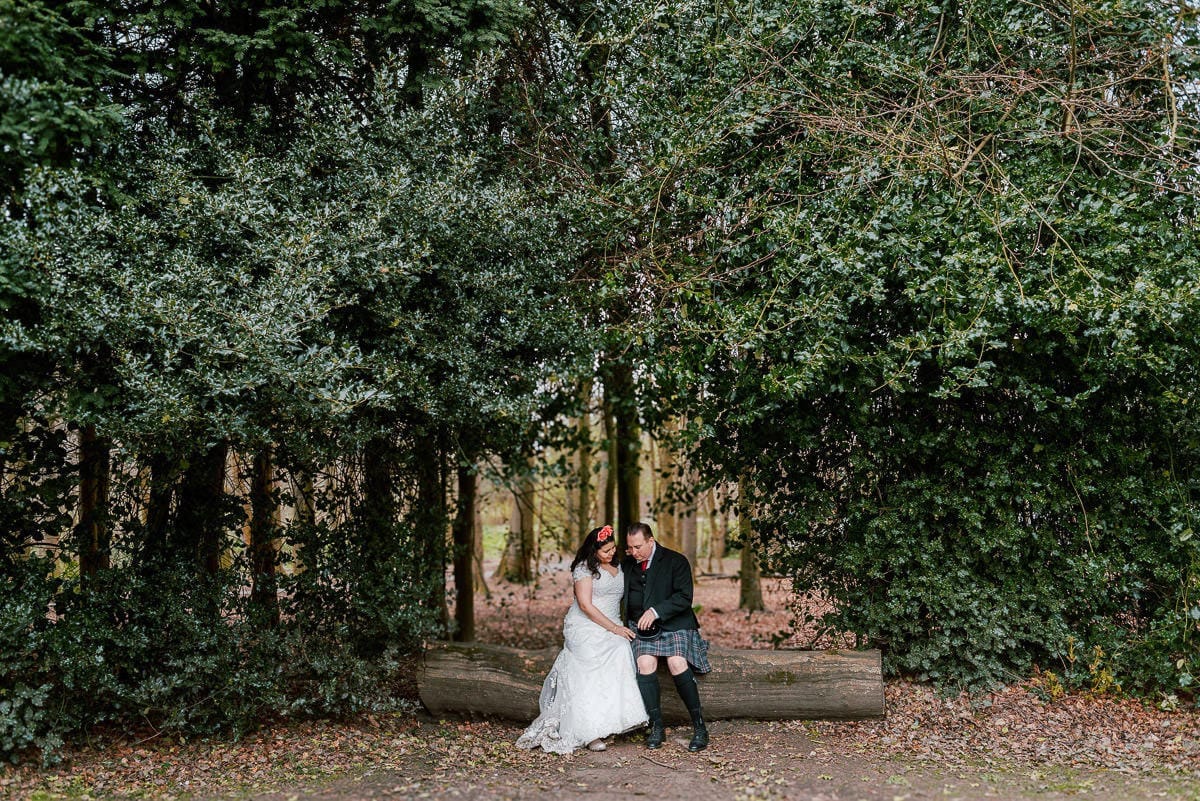
Pollok Country Park is on Glasgow’s south side. 360 acres of woodland, the River White Cart cutting through it, and the famous Highland cattle which on a cool, dry Monday morning could not have been less interested in a Mexican photographer or a bride wearing a borrowed white dress. The day was Glasgow-typical for late April: a high near 11°C, dry, the leaves still soft and not yet at full summer density.
Meiko was moving more carefully than the day before. The dancing had asked something of her ankle and she would have it looked at later that day. She did not, that morning, complain about it. She walked.


The archive
Eleven years later
I shoot fewer than thirty weddings a year. On purpose. Most of them happen in Mexico — Valle de Guadalupe, mostly, and across destination wedding venues elsewhere in Mexico, where the couples I work with often bring their families across continents to a single day. Glasgow was one of the years I went the other direction. I went for friendship.
What it left was a frame of reference I still use. Whenever someone in CDMX or Houston or Los Angeles is bringing half their family to Mexico for a wedding and is quietly worried that the cultural seams will show — I think about the lazo. The seams should show. The harder a wedding works to honor more than one tradition, the more memorable it becomes. Pick one object that is genuinely all of you, and let everything else assemble around it.
If you’re trying to figure out whether a Mexican destination wedding is the right shape for your day, the destination wedding planning guide gives you a place to start the math.
Once a year, on the Saturday or Sunday closest to April 19, I send Meiko a note. She usually answers from somewhere — an airport, a conference, the next chapter of the doctorate. The lazo is folded somewhere in a box now. The cranes are still cranes. Eleven years on, the photographs still travel, and that is the thing about the right archive: it doesn’t preserve the day. It returns it.